The most typical symptom of a panic attack is a feeling of suffocation — you could also call it shortness of breath. Because of it, people feel an extreme terror that they might choke to death, and they rush to the emergency room.
Of course, the suffocation and breathlessness of a panic attack do not kill anyone. Nothing has gone wrong with the lungs or the heart, either; most tests come back normal. So why does a panic attack bring on suffocation and breathlessness?

The usual interpretation — the answer medicine gives — goes like this:
"You are having anxious thoughts, so your body is reacting to the anxiety. You are misinterpreting what your body feels."
In other words, stress and the like create the panic attack and the suffocation; in reality nothing is stopping you from breathing, and you are simply overreacting.
Is that interpretation right? My answer is no.
A study was published in 2013. Since then, the front line of panic disorder research no longer supports the old hypothesis of panic disorder. There were twin sisters whose amygdalae had been destroyed in childhood by a genetic disease. The amygdala produces anxiety and fear responses, so the old hypothesis held that the amygdala causes panic attacks: under stress, the amygdala is stimulated and sets off an attack. That hypothesis does explain part of panic. But without an amygdala, these twins should have been unable to react to anxiety and stress — and so unable to have a panic attack. Yet when they were given carbon dioxide to inhale, they had panic attacks, to everyone's surprise. And the attack they had was suffocation: they could not breathe. From this study on, the amygdala hypothesis stepped back. Breathlessness and suffocation from a panic attack can appear without anxiety, fear or stress. Then what is the cause?
Donald Klein, a pioneer of panic disorder research, wrote in a 1993 paper that "panic is not fear." That is to say, panic attacks do not arise only from anxiety, fear or stress. Klein pointed to abnormal respiratory function as a cause of panic attacks and proposed the "false suffocation alarm" hypothesis: the breathlessness and suffocation of a panic attack come not from anxiety, fear or stress but from a disturbance of breathing.
So how does breathing go wrong? Panic research usually points to hyperventilation during attacks and to carbon dioxide levels: when people hyperventilate in an attack, the CO2 level in their blood is low, so the advice is to bring blood CO2 back to normal.
But anyone who has lived with panic disorder will know. Think back carefully to how your breathing fails during an attack. Of inhalation (the in-breath) and exhalation (the out-breath), it is the out-breath that won't come when an attack hits. So the person keeps trying to breathe in. When a panic attack comes, the out-breath gets shorter and the in-breath gets longer.
Respiratory medicine calls this dynamic hyperinflation. In the figure below, the left side is normal breathing. Above normal breathing lies the extra in-breath zone, and below it the extra out-breath zone.
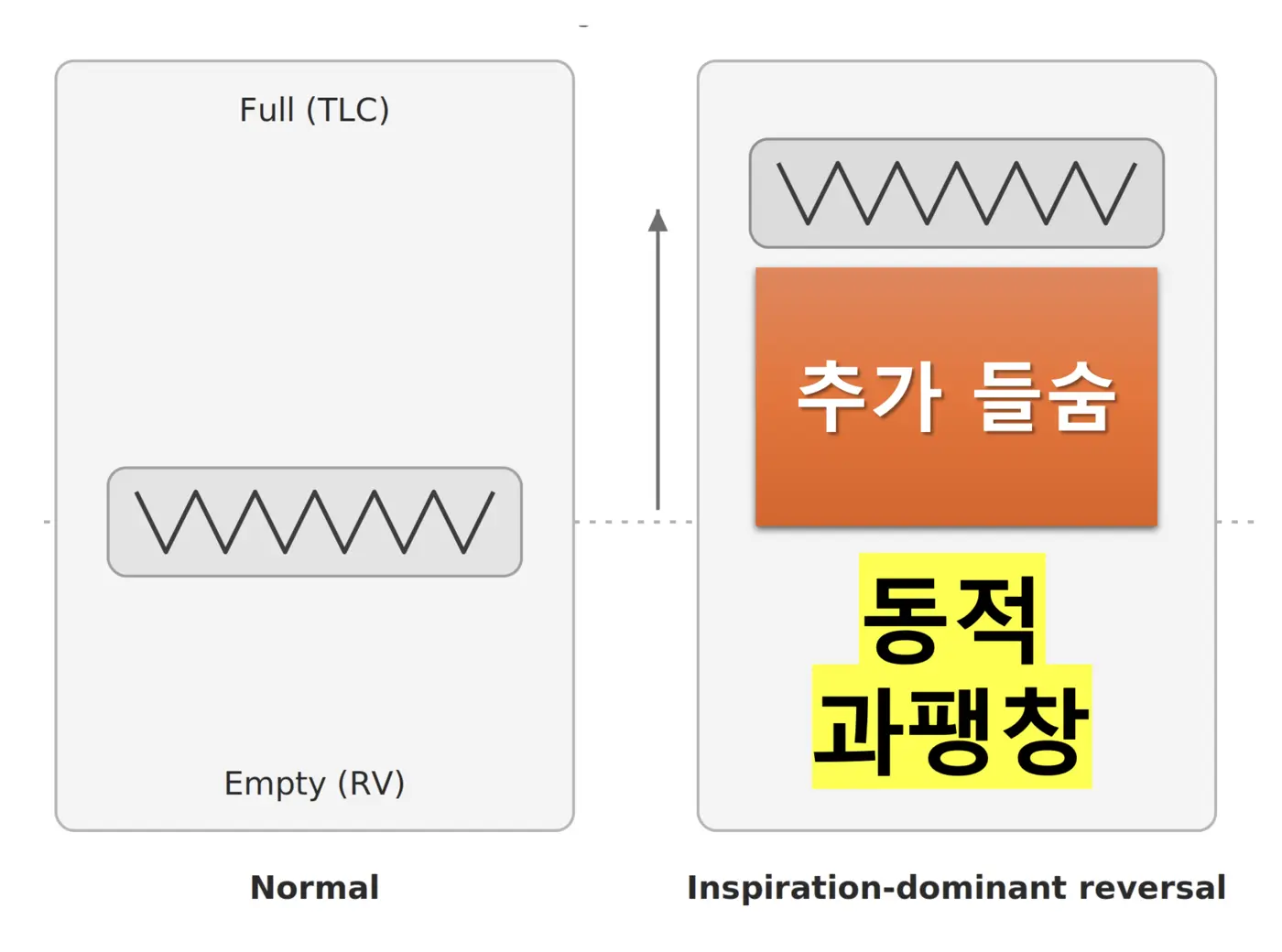
But the breathing rhythm adds extra in-breaths, so you end up breathing with lungs already packed with air. This is called dynamic hyperinflation. It happens because, for some reason, the out-breath does not go through properly in this kind of breathing — and because it doesn't, you keep breathing before the air has fully left the lungs. Respiratory medicine names several conditions in which dynamic hyperinflation readily appears, and panic disorder is one of them.
In short, a panic attack is the rhythm of breathing shifting, for some reason, into an inhalation-dominant pattern.
Once inhalation dominates, breathing out becomes hard and breathing turns toward pulling air in. Repeat this a few times and you feel you are suffocating.
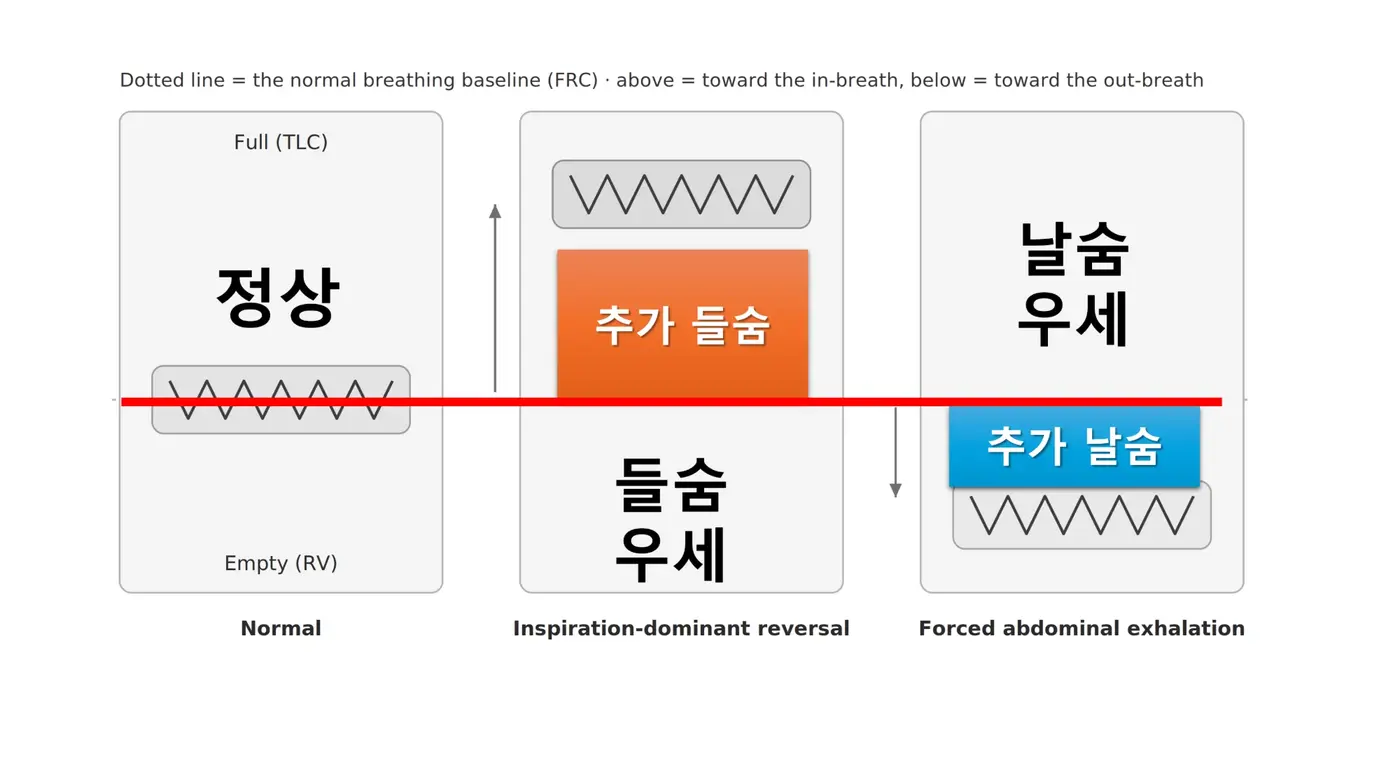
Donald Klein had already described panic attacks with the false suffocation hypothesis in 1993. There may be many reasons, but for some reason dynamic hyperinflation suddenly appears and the breathing rhythm turns inhalation-dominant.
The fear of dying that comes with the suffocation and breathlessness of a panic attack is secondary. Anxiety and fear are not what cause the suffocation. Through this research Klein showed that carbon dioxide can trigger panic: people prone to panic disorder can have an attack when exposed to carbon dioxide.
This is why panic attacks so often happen in crowded, stuffy places. Where people are packed together, carbon dioxide rises. This is called sick building syndrome. Most of us work crowded together inside buildings, and public transport is one of those places too, so CO2 climbs wherever people gather. Sick building symptoms are said to appear from around 800 ppm: headache, poor concentration, a heavy head, fatigue, emotional instability and more. Research shows that a crowded lecture room can easily go past 3,000 ppm, and that at concentrations like these even healthy people lose higher thinking functions such as strategic thinking.
People with a sensitivity to panic disorder can be affected when CO2 rises in a crowded space.
So how should you respond?
It won't be easy during an attack, but you have to breathe out — force it if you must. In dynamic hyperinflation the out-breath is held back, so you have to push the air out. Anyone who has been through it knows the out-breath won't come easily. Even so, the answer is to force it out. And the same goes for everyday life. People with panic disorder don't only struggle to breathe during attacks; breathing is uncomfortable the rest of the time too, because their breathing rhythm is tilted toward dynamic hyperinflation. Symptoms that stay uncomfortable even when there is no attack are called residual symptoms.
Ventilate often, too. Air out the space where you work, and step outside yourself to breathe fresh air.
Once you understand what the suffocation and breathlessness of a panic attack really are, they stop being frightening.
References
- Feinstein JS, et al. Fear and panic in humans with bilateral amygdala damage. Nature Neuroscience 2013;16(3):270–272. doi:10.1038/nn.3323
- Klein DF. False suffocation alarms, spontaneous panics, and related conditions: an integrative hypothesis. Archives of General Psychiatry 1993;50(4):306–317. doi:10.1001/archpsyc.1993.01820160076009
- Satish U, et al. Is CO2 an indoor pollutant? Direct effects of low-to-moderate CO2 concentrations on human decision-making performance. Environmental Health Perspectives 2012;120(12):1671–1677. doi:10.1289/ehp.1104789