"Nothing stressful has been going on lately — so why did it come back?"
"I was just sitting there, not thinking about anything, and suddenly I couldn't breathe."
People who have had panic attacks say this often.
Look up the causes of panic disorder and most sources talk about stress and anxiety. But when an attack arrives on a day when nothing was happening, that explanation alone doesn't answer the question.
Today I want to talk about one of the lesser-known causes of panic disorder: lactate, a substance inside the body.
1. Panic disorder has more than one cause
Panic disorder does not have a single cause. Stress, genetics and the body's biological factors act together.
Some of the biological factors have been confirmed by experiment. Give certain substances to a person with panic disorder and an attack begins on the spot. These are called panicogens — panic-provoking substances. The first one identified was lactate.
👉 A panic attack can start from a substance in the body alone, without any thought or stress.
2. Two points Why Panic Keeps Coming Back makes about lactate
In my book Why Panic Keeps Coming Back, I made two points about lactate.
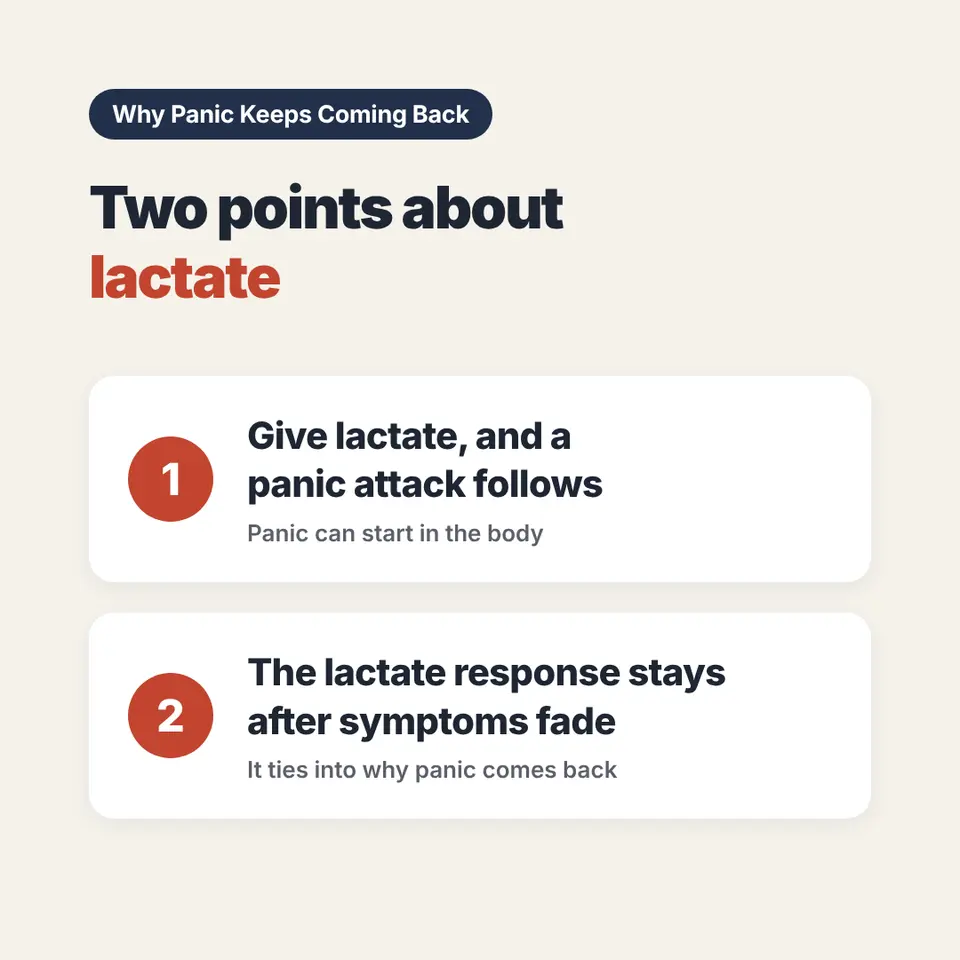
- Give lactate to a person with panic disorder, and a panic attack follows.
- Even after panic symptoms fade, the brain's lactate response remains.
The first is evidence that panic can begin in the body; the second connects to why panic comes back. Let's look at the research behind each in turn.
3. What is lactate?
Lactate is a substance the body produces alongside energy.
It isn't foreign. Muscles and the brain make it all the time as they work, and it is used again as fuel or cleared away. It is in everyone's body.
4. The experiment where a lactate infusion set off panic attacks (1967)
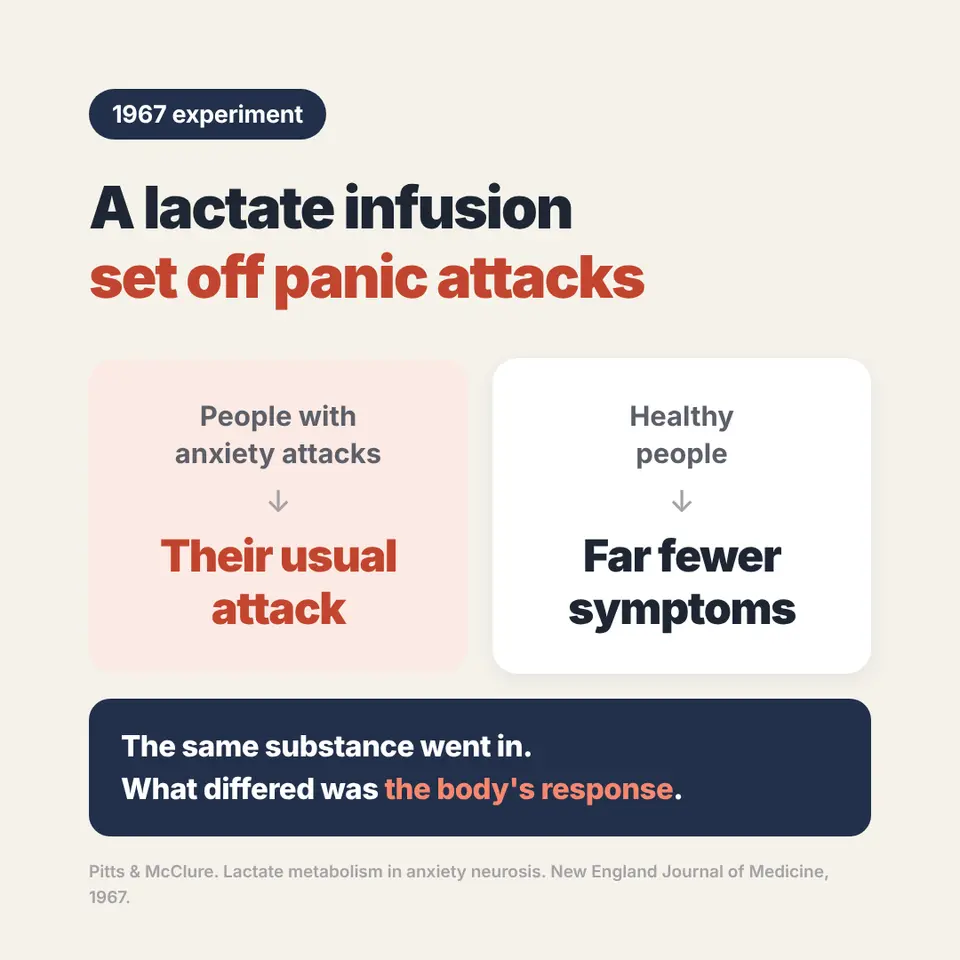
The first piece of evidence is a 1967 study by Pitts and McClure in the United States, "Lactate metabolism in anxiety neurosis" (New England Journal of Medicine, 1967).
The researchers infused a sodium lactate solution into a vein over 20 minutes, in people who had been having anxiety attacks and in healthy people. Those with a history of anxiety attacks had attacks much like their usual ones during the infusion. The healthy people had far fewer and milder symptoms. When glucose in saline was infused instead, symptoms hardly appeared.
"Anxiety neurosis" at the time corresponds to what we now call panic disorder. This was the first study to produce panic attacks in the laboratory.
💡 The same substance went in, but only one group had attacks. The difference lay not in the substance but in the body reacting to it.
5. A lactate response that remains after symptoms fade (2013)
The second piece of evidence is a 2013 study by Maddock and colleagues, "Abnormal activity-dependent brain lactate and glutamate+glutamine responses in panic disorder" (Biological Psychiatry, 2013).
This time no lactate was given. Participants watched a flickering pattern on a screen to make the brain work, and the researchers measured how much brain lactate rose.
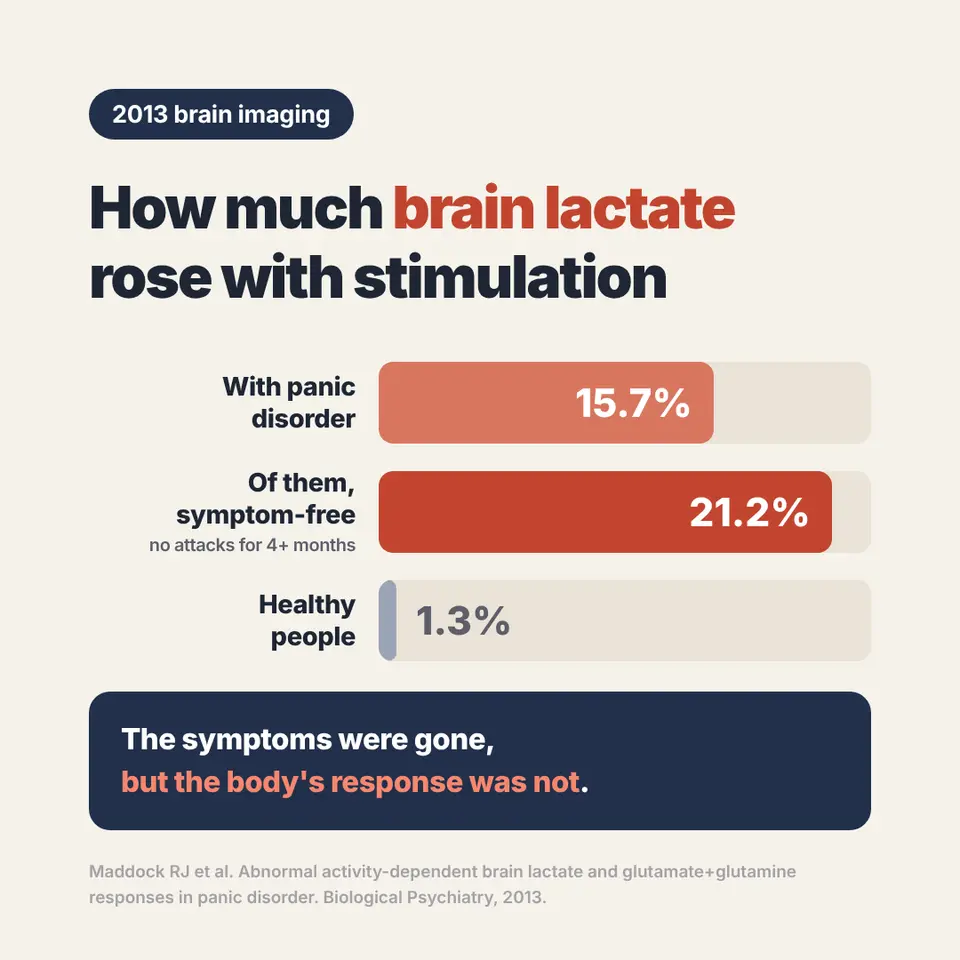
- People with panic disorder: an average rise of 15.7%
- Healthy people: an average rise of 1.3%
What deserves attention comes next. Of the 21 people with panic disorder, 13 had gone more than four months without attacks or clear symptoms. Their lactate also rose — by 21.2%. They were no different from those who currently had symptoms.
The researchers interpreted this not as a passing state but as a trait the person carries.
👉 The symptoms were gone, but the body's response was not.
6. Why panic disorder comes back when there are no symptoms
From here on, this is my interpretation.
Maddock's study did not follow the same people before and after treatment. So it does not directly show that "relapse happens because of the lactate response."
Still, this is how I see it. Attacks stopping and the body's attack-producing conditions changing are two different things. If the same response remains in someone whose symptoms have faded, that person can relapse when the conditions line up again.
In the clinic I often hear, "I thought I was completely better, and then it came back." I believe this is one of the reasons why.
7. So what should be looked after?
Treating and managing panic disorder means looking not only at anxiety and thoughts, but also at substances in the body and the body's response to them.
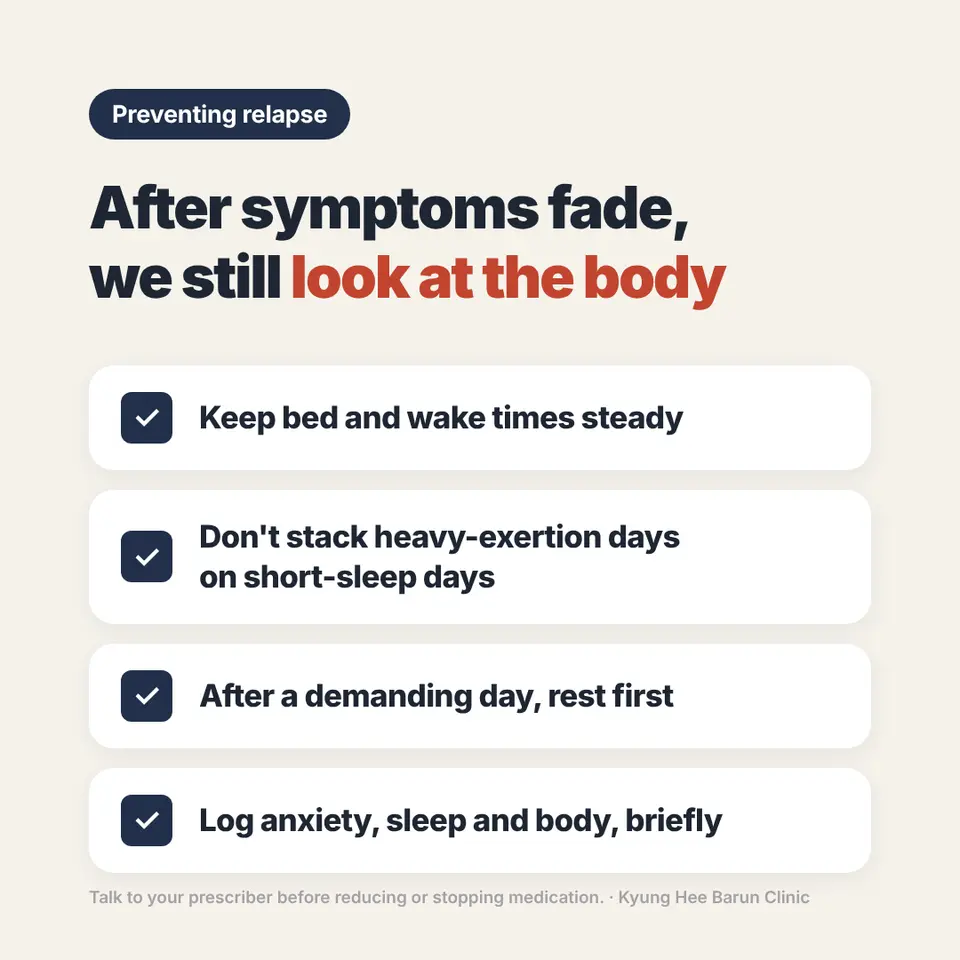
Lactate is produced when the body spends energy. So I look at how much energy the body has spent, and how well it has recovered afterwards.
- Keep the times you go to bed and get up steady
- Don't let days of heavy physical exertion coincide with days of too little sleep
- After a demanding day, make time to rest first
- Briefly record each day's anxiety, sleep and physical state to see the trend
If you are taking medication, talk to the doctor who prescribed it before reducing or stopping it.
8. Signs it's time to see a clinician
- Attacks come even on days without stress
- You keep improving and then relapsing
- No attacks, but chest tightness, a sense of not getting a full breath, or a body that tires easily remain
- The places you avoid are increasing
If you notice these changes, it is worth looking at the state of the body as well. What that state is differs from person to person, and it can only be known by examining and checking in person.
Panic disorder causes and lactate: frequently asked questions
Q1. Can a lactate test tell whether I have panic disorder?
No. These studies used research methods such as intravenous infusion and brain imaging. Panic disorder is not diagnosed from the lactate level in an ordinary blood test.
Q2. If I have no symptoms, am I fully recovered?
Attacks stopping is a major improvement. But in the 2013 study, even people who had been symptom-free for more than four months showed a larger brain lactate response than healthy people. It is worth continuing to look after the body after symptoms fade.
Q3. Is lactate bad for the body?
No. Lactate is made in everyone's body and used again. In the 1967 experiment, healthy people given the same lactate had far fewer symptoms. What differed was not the substance but the body reacting to it.
Tests are normal — so why does it still hurt? (Residual symptoms)
Panic relapse gives a warning two months ahead
References
- Pitts FN, McClure JN. Lactate metabolism in anxiety neurosis. N Engl J Med. 1967;277(25):1329–1336. doi:10.1056/NEJM196712212772502
- Maddock RJ, Buonocore MH, Miller AR, Yoon JH, Soosman SK, Unruh AM. Abnormal activity-dependent brain lactate and glutamate+glutamine responses in panic disorder. Biol Psychiatry. 2013;73(11):1111–1119. doi:10.1016/j.biopsych.2012.12.015
- Joo Jin-won. Why Panic Keeps Coming Back. (Amazon)